A documentary film by Nati Baratz
WINNER - Special Jury Award at 2009 Full Frame Festival
WINNER - Best Documentary Feature - 2009 RiverRun Film Festival
This documentary is best viewed in a theater with a full screen to present to its best advantage the beauty of Napal, of India, of the world from whenst the Lama of India preside.
This is a film that shows the selection process of the child who is deemed the reincarnation of the recently departed Lama: how the child is found, taken from its parents to live in a monestery, the care, and love afforded him by his diciple-in-charge, his "Big Uncle"
What fascinated me is the evidence of such intense unmitigated love of this selected child; the process involved in taking him from a rural, unsophisticated limited world into the highest eschelons of Buddhism.
I fell instantly in love with the Big Uncle and you will too even though the religion makes no sense to me, a western woman raised in an atheist home
but then this interaction of cultures is confronted by us all almost daily when we call American Express, or Sprint or any of the American based companies in search of help. It is to India we are often directed to get assistance with our "sophisticated" way of life.
A beautiful, rich documentary to be cherished.
Linda Z
WBAI WOMEN'S COLLECTIVE
Film opens in New York at Film Forum on Wednesday JUNE 3
National Release will follow in June / July
Friday, May 22, 2009


Thursday, May 21, 2009
Seraphine: The discovery of a woman artist
Martin Provos: Director
This film forms the basis for rich discussion on the feminist movement and how we have failed to educate the general public on the ill treatment of Western women even or most obviously under the guise of being charitable.
The film illustrates state of the art in cinematic excellence, in the ability to present every frame as if it is a piece of fine art in itself.
But the subject matter is so distorted in favor of men, the prejudicial workings of a man's mind, and the harmful appeal of women's fantasy life that it detracts from the otherwise fine aspects of the film.
Seraphine is a middle age woman in her forties who has been living on her own, making money and painting in her free time. She calculates to a fraction of a franc how much money she needs for her maintenance, how much to charge per tasks. She sets about to make ends meet and she does just that. She has mastered the rudiments of her world.
Along comes a "famous " man, a man on a shining white horse and undermines her, makes her appear not just in the narrative of the film but the film Director continues this prejudicial impression by showing her "child like" visage above her work as if she is a child, a grown one, a super talented one but a child with an almost vacuous face, titled towards the sky because her only understanding of her world is that she is not entirely of this world.
But Seraphine is an adult. She lives intellectually alone, has little to do with other people. One can almost count the number of words she utters in her entire life time, if this rendition of her life is to be believed. Does this mean that no attempt need be made to uncover her strengths, her truths beyond the obvious?
The art dealer on the white horse takes away Seraphine's ability to determine without benefit of his help what art supplies she needs, how much money she needs to live on and whether or not she is to continue in her chosen line of work. In the process of thinking he is elevating her into a more dignified position in society he is taking away her personal dignity and substituting his notion of who and what she should be.
And then he fails. Without apology. He can not deliver on what he promised, assured her would be hers. He and his sister insinuate this is all beyond her comprehension because it involves world events of catastrophic capitalistic failures world wide and they respond to her by treating her even more like a child, "she simply can not understand it is deemed beyond her comprehension. But is financial difficulty of any type truly beyond Seraphine's comprehension or is it more accurately stated as being beyond the comprehension of this gentlemen of former "means".
What Seraphine can not understand, and what he is not saying, is how profoundly he has failed. That he took her dignity, her world, destroyed it to make her into something less than competent and then failed to provide the essentials for her to be sustained in his artificially constructed parasitic Paradise.
This film is a tragedy with all the underpinnings of appeal to the male dominated world and the middle upper class way of thinking of the poor, the menial domestic worker viewed yet again as inferior, rather than as intelligent; The lower class is seen as incapable of understanding anything beyond the immediate even if they are gifted artists.
To place this woman, who has so little substantive interaction with others, into an Asyllum, an institution overly crowded by people starved for interaction is a CRIME.
This film is a tragedy, a painful unfolding of how cruelly we treat one another not out of malice but from our arrogant ignorance.
I recommend it be seen as the basis of a discussion on who we are and how we can communicate better more charitably towards one another.
LindaZises
WBAI Women's Collective
CriticalWomen@blogspot.com
This film forms the basis for rich discussion on the feminist movement and how we have failed to educate the general public on the ill treatment of Western women even or most obviously under the guise of being charitable.
The film illustrates state of the art in cinematic excellence, in the ability to present every frame as if it is a piece of fine art in itself.
But the subject matter is so distorted in favor of men, the prejudicial workings of a man's mind, and the harmful appeal of women's fantasy life that it detracts from the otherwise fine aspects of the film.
Seraphine is a middle age woman in her forties who has been living on her own, making money and painting in her free time. She calculates to a fraction of a franc how much money she needs for her maintenance, how much to charge per tasks. She sets about to make ends meet and she does just that. She has mastered the rudiments of her world.
Along comes a "famous " man, a man on a shining white horse and undermines her, makes her appear not just in the narrative of the film but the film Director continues this prejudicial impression by showing her "child like" visage above her work as if she is a child, a grown one, a super talented one but a child with an almost vacuous face, titled towards the sky because her only understanding of her world is that she is not entirely of this world.
But Seraphine is an adult. She lives intellectually alone, has little to do with other people. One can almost count the number of words she utters in her entire life time, if this rendition of her life is to be believed. Does this mean that no attempt need be made to uncover her strengths, her truths beyond the obvious?
The art dealer on the white horse takes away Seraphine's ability to determine without benefit of his help what art supplies she needs, how much money she needs to live on and whether or not she is to continue in her chosen line of work. In the process of thinking he is elevating her into a more dignified position in society he is taking away her personal dignity and substituting his notion of who and what she should be.
And then he fails. Without apology. He can not deliver on what he promised, assured her would be hers. He and his sister insinuate this is all beyond her comprehension because it involves world events of catastrophic capitalistic failures world wide and they respond to her by treating her even more like a child, "she simply can not understand it is deemed beyond her comprehension. But is financial difficulty of any type truly beyond Seraphine's comprehension or is it more accurately stated as being beyond the comprehension of this gentlemen of former "means".
What Seraphine can not understand, and what he is not saying, is how profoundly he has failed. That he took her dignity, her world, destroyed it to make her into something less than competent and then failed to provide the essentials for her to be sustained in his artificially constructed parasitic Paradise.
This film is a tragedy with all the underpinnings of appeal to the male dominated world and the middle upper class way of thinking of the poor, the menial domestic worker viewed yet again as inferior, rather than as intelligent; The lower class is seen as incapable of understanding anything beyond the immediate even if they are gifted artists.
To place this woman, who has so little substantive interaction with others, into an Asyllum, an institution overly crowded by people starved for interaction is a CRIME.
This film is a tragedy, a painful unfolding of how cruelly we treat one another not out of malice but from our arrogant ignorance.
I recommend it be seen as the basis of a discussion on who we are and how we can communicate better more charitably towards one another.
LindaZises
WBAI Women's Collective
CriticalWomen@blogspot.com
Saturday, May 16, 2009
WHAT GOES UP: The Making of our Heroes

Jonathan Glatzer Director
Writers:
Jonathan Glatzer (writer)
Robert Lawson (writer)
Steve Coogan, Josh Peck, Hilary Duff and Molly Shannon
Set as a quiet background, a seemingly unobtrusive event, is the Space Shuttle Challenger tragedy. Add to that the images not discussed of the school teacher, Sam Calailucci's plummet to his death off a roof top. Then add the humor that only young "misfit" teenagers can muster juxtaposed against the too well established adult world and what do you have, WHATgoesUP
What stays down on earth is our creation of heroes in our midst.
WHATgoesUP is the story of the reported Babbitt(Steve Coogan) obsessed by the death(suicide) of a local hero. He is reassigned to the New Hampshire hometown of the doomed teacher Charitia McAuliffe(an old college buddy) and soon to be suicide victim.
Two suicides, one failed shuttle with resounding heroic effects and youth confronting the advent of life in the troubled adult world.
And this is a comedy, a seemingly light hearted film for those who see films for the pleasure rather than the message to be learned or understood
My hero is the film maker who dared to go beyond the Judeo-Christian ethics and morality with which we are too familiar and accept too readily its limitations on our ability to live our lives as we want. He replaces this time hononred guide to a "good life" with a discussion of Socrates, as the true hero in our midst.
Suicide victims do not go to hell and ABORTION is shown, (the first time I have seen it in a main stream film) without dire consequences. The teenage girl( Molly Shannon ) is accompanied not by her parents and not with their consent or knowledge but by a girlfriend ( Hilary Duff), someone with true compassion and understanding of the necessity of the procedure.
And Molly Shannon's character survives! She becomes a hero, a mature young adult whose wisdom is well worth listening to.
I recommend this film because of the quiet, amusing and convincing way it presents highly charged ideas. My only regret is that the film makers didn't have the abundance of finacial backing to make this film an exravaganza of robust detail. They seem to have spent their limited funds on quality acting rather than expensive and elaborate sets.
Who can fault that!
LindaZises
WBAI Women's Collective
Criticalwomen@blogspot.com
Saturday, May 9, 2009
Downloading Nancy : Self mutilation and more
Johan Renck: Director
Writer: Pamela Cuming, Lee Ross
Cast: Maria Bello, Jason Patric, Rufus Sewel, Amy Brenneman
This film is not for everyone. In all probability it will not make huge profit at the box office. However, it explores a subject of real dimension that promises to grow in proportion as the Internet continues to dominate our lives, our ability and means of interacting with one another.
This is a story told with exceptional acting and palatable insidious pain as the viewer is forced to see another way towards liberation from inner tormoil.
Nancy addresses her pyschological pain by inflicting physical pain of increasing intensity upon her body. She deems a sharp razor a requisite item to be thrown into her pocket book cosmetic bag when she leaves the house.
With grueling precision Downloading Nancy depicts Nancy's progress towards liberation in the execution of a plan established on the Internet with a man committed administering her pain and ultimate demise; this time without use of the computer. In the process they go beyond their 'plan' into the realm of 'normal' human interaction that we are all familiar with.
There is a pivotal moment captured in the image of the 'man in the bath tub'.
During the course of my viewing experience I have seen (as you probably have) well over one hundred scenes of an adult in a bathtub with or without benefit of bubble bath. But Christopher Doyle offers an aerial view of the man, the bathtub, the surrounding ceramic that takes the banal and elevates this familiar image into breathtaking visual moment.
For me this visual transformation captures the essence of the film: there is nothing shown that we do not know but to know this human process in search of easement of psychological pain through the eyes of Downloading Nancy's creators is an entirely new and awesome experience.
Downloading Nancy might be a first brutally honest film on self mutilation but I am confident it won't be the last.
Release Date: June 5, 2009 (Limited)
Linda Zises
WBAI Women's Colective
Writer: Pamela Cuming, Lee Ross
Cast: Maria Bello, Jason Patric, Rufus Sewel, Amy Brenneman
This film is not for everyone. In all probability it will not make huge profit at the box office. However, it explores a subject of real dimension that promises to grow in proportion as the Internet continues to dominate our lives, our ability and means of interacting with one another.
This is a story told with exceptional acting and palatable insidious pain as the viewer is forced to see another way towards liberation from inner tormoil.
Nancy addresses her pyschological pain by inflicting physical pain of increasing intensity upon her body. She deems a sharp razor a requisite item to be thrown into her pocket book cosmetic bag when she leaves the house.
With grueling precision Downloading Nancy depicts Nancy's progress towards liberation in the execution of a plan established on the Internet with a man committed administering her pain and ultimate demise; this time without use of the computer. In the process they go beyond their 'plan' into the realm of 'normal' human interaction that we are all familiar with.
There is a pivotal moment captured in the image of the 'man in the bath tub'.
During the course of my viewing experience I have seen (as you probably have) well over one hundred scenes of an adult in a bathtub with or without benefit of bubble bath. But Christopher Doyle offers an aerial view of the man, the bathtub, the surrounding ceramic that takes the banal and elevates this familiar image into breathtaking visual moment.
For me this visual transformation captures the essence of the film: there is nothing shown that we do not know but to know this human process in search of easement of psychological pain through the eyes of Downloading Nancy's creators is an entirely new and awesome experience.
Downloading Nancy might be a first brutally honest film on self mutilation but I am confident it won't be the last.
Release Date: June 5, 2009 (Limited)
Linda Zises
WBAI Women's Colective
Wednesday, May 6, 2009
Jerichow: Black Cloud Rising
Director: Christian Petzold
Cast: Benno Fürmann ... Thomas
Nina Hoss ... Laura
Hilmi Sözer ... Ali Özkan
Although many Americans live with the guilt or jubilation from the dropping of the Hiroshima bomb that resulted in an en masse destruction of civilian life, Jerichow brings that event into clear focus with the use of three characters, (two men and a woman), moving slowly into the depth of their lives, fueled by the progressive almost predictable interactions.
At its core Jerichow is an achievement of the impossible: to bring world level events of War, of the ngredients of climate change into the human everyday experience of ordinary people. This film, like none I have ever seen, talks to me about the world of destruction, of the black cloud that is us and also hovers over us, whether we see it or not.
Jerichow isn't for everyone but everyone who sees it will applaud it as one of the great moments in film.
Opens May 15, 2009 in New York City: Fim Forum
German subtitles
Linda Zises
WBAI Women's Collective
Cast: Benno Fürmann ... Thomas
Nina Hoss ... Laura
Hilmi Sözer ... Ali Özkan
Although many Americans live with the guilt or jubilation from the dropping of the Hiroshima bomb that resulted in an en masse destruction of civilian life, Jerichow brings that event into clear focus with the use of three characters, (two men and a woman), moving slowly into the depth of their lives, fueled by the progressive almost predictable interactions.
At its core Jerichow is an achievement of the impossible: to bring world level events of War, of the ngredients of climate change into the human everyday experience of ordinary people. This film, like none I have ever seen, talks to me about the world of destruction, of the black cloud that is us and also hovers over us, whether we see it or not.
Jerichow isn't for everyone but everyone who sees it will applaud it as one of the great moments in film.
Opens May 15, 2009 in New York City: Fim Forum
German subtitles
Linda Zises
WBAI Women's Collective
Sunday, May 3, 2009
Jane Harmen, follow-up on my April 23,2009 blogspot.

U.S. to Drop Spy Case Against Pro-Israel Lobbyists
A New York Times follow up on the Jane Harmen article posted earlier
Although it was my intention to bring to light the misuse of an attractive Caucasian woman in politics, this New York Times May 2, 2009 article points to a lot more going on than the undisclosed wiretapping (seemingly without provocation) of one California politician of note
(this is a snipit of the whole)
By NEIL A. LEWIS and DAVID JOHNSTON
Published: May 1, 2009
WASHINGTON — A case that began four years ago with the tantalizing and volatile premise that officials of a major pro-Israel lobbying organization were illegally trafficking in sensitive national security information collapsed on Friday as prosecutors asked that all charges be withdrawn.
The investigation of Mr. Rosen and Mr. Weissman also surfaced recently in news reports that Representative Jane Harman, a California Democrat long involved in intelligence matters, was overheard on a government wiretap discussing the case. As reported by Congressional Quarterly, which covers Capitol Hill, and The New York Times, Ms. Harman was overheard agreeing with an Israeli intelligence operative to try to intercede with Bush administration officials to obtain leniency for Mr. Rosen and Mr. Weissman in exchange for help in persuading Democratic leaders to make her chairwoman of the House Intelligence Committee.
Ms. Harman has denied interceding for Mr. Rosen and Mr. Weissman, and has expressed anger that she was wiretapped. She is to be among the featured speakers at the Aipac conference next week.
Over government objections, Judge Ellis had also ruled that the defense could call as witnesses several senior Bush administration foreign policy officials to demonstrate that what occurred was part of the continuing process of information trading and did not involve anything nefarious. The defense lawyers were planning to call as witnesses former Secretary of State Condoleezza Rice; Stephen J. Hadley, the former national security adviser; and several others. Government policy makers indicated they were clearly uncomfortable with senior officials’ testifying in open court over policy deliberations.
The government’s motion to dismiss said the government was obliged take a final review of the case to consider “the likelihood that classified information will be revealed at trial, any damage to the national security that might result from a disclosure of classified information and the likelihood the government would prevail at trial.”
Thursday, April 30, 2009
Goodbye Solo: Suicide Revisited
Director: Ramin Bahrani
Winner: Venice Film Festival International Critics' Prize
A slow-moving, seemingly uneventful film that tackles the issue of suicide: not from the victim's prospective but from the point of view of the survivor who sees the end of life as we know it within clear sight. What to do?
This film is the struggle between life and death, portrayed through the encounter of two very different people, a Senegal immigrant man and an American man who was once a full blooded motor cycle, beer drinking, tattooed man of the world who is now "over the hill".
There is a tedium in watching the slow motions that pass as events between the two men, the Senegalese is the taxi driver "Solo" and William the passenger about to end his life.
So many head shots, so little motion. Only the car seems to move. Although the film director is enamored with the car, the motion, the confining of the space allowed, i am more claustrophobic and the endless car trips did not ease the tension I feel within a moving car.
But the message, the process of being able to let go, to stop trying to save a man's life particularly when he doesn't want to be saved is a forceful one, a compelling moment to think about when or if such a moment is put in our way.
Suicide is always a difficult subject to discuss. Whether it is because of the religious taboo against it or the fear that it is a contagious event, there is rarely the question of why not. But, why not? We may not have a choice about being born but certainly there is nothing fundamentally wrong, nor impossible in our ability to end our own life for whatever reason.
Let go. That is the powerful message that informs on Goodbye Solo.
Linda Zises
WBAI Women's Collective
Criticalwomen.net
Winner: Venice Film Festival International Critics' Prize
A slow-moving, seemingly uneventful film that tackles the issue of suicide: not from the victim's prospective but from the point of view of the survivor who sees the end of life as we know it within clear sight. What to do?
This film is the struggle between life and death, portrayed through the encounter of two very different people, a Senegal immigrant man and an American man who was once a full blooded motor cycle, beer drinking, tattooed man of the world who is now "over the hill".
There is a tedium in watching the slow motions that pass as events between the two men, the Senegalese is the taxi driver "Solo" and William the passenger about to end his life.
So many head shots, so little motion. Only the car seems to move. Although the film director is enamored with the car, the motion, the confining of the space allowed, i am more claustrophobic and the endless car trips did not ease the tension I feel within a moving car.
But the message, the process of being able to let go, to stop trying to save a man's life particularly when he doesn't want to be saved is a forceful one, a compelling moment to think about when or if such a moment is put in our way.
Suicide is always a difficult subject to discuss. Whether it is because of the religious taboo against it or the fear that it is a contagious event, there is rarely the question of why not. But, why not? We may not have a choice about being born but certainly there is nothing fundamentally wrong, nor impossible in our ability to end our own life for whatever reason.
Let go. That is the powerful message that informs on Goodbye Solo.
Linda Zises
WBAI Women's Collective
Criticalwomen.net
American Violet

The Texas Raids Where Men And Women Are Given Equal Maltreatment
Directed by Tim Disney
Starring Alfre Woodard, Michael O’Keefe, Tim Blake Nelson, Will Patton, Charles S. Dutton, Xzibit, and newcomer Nicole Beharie
Based on real events and set in a small Texas town in the midst of the 2000 Bush/Gore presidential election.
AMERICAN VIOLET tells the astonishing story of Dee Roberts (critically hailed newcomer Nicole Beharie), a 24 year old African-American single mother of four who is wrongfully swept up in a drug raid. A raid that is periodically visited on the denizens of the Texas housing projects, and the threat of its re-occurrence does not stop with the end of the film.
The inside view of the prison was riveting. I had no idea of the conditions, the lack of humanity that people incarcerated, even if not guilty, are afforded.
This is a piece of history we need to know. The trip to knowledge that Tim Disney offers is an engrossing, enjoyable, yet disturbing adventure that will not be forgotten by those who see the film. It isn't a Hollywood extravaganza, but a slice of life that draws us into the moment and doesn't let us go, even after the lights come up.
The acting is stunning, the music is so perfect and the story is strong. A good job, a necessary work of art.
Samuel Goldwyn Films releases American Violet April 17th, 2009 nationwide
Linda Z
Crotocal women
wbai radio
Wednesday, April 29, 2009
Notes on a Scandal
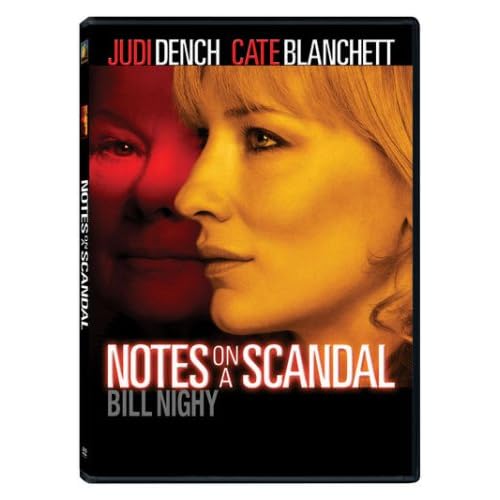
Notes on a Scandal (2006) DVD
Sexuality, Age and Attraction: what is moral, when?
Director: Richard Eyre
Starring: Judi Dench, Cate Blanchett
A twist and turn film with great acting and a moral message that encompasses age, sex, the double standard and the public, the moral majority who relish an attractive woman gone astray. Notes of a Scandal will bring moments of spontaneous fun, clever insight into human nature and moments of repulsion and anger to those who think sex with a young underage person is wrong, reprehensible without equivocation unless sanctioned by marriage.
In Notes of a Scandal morality is turned upside down, the good and bad dichotomy reversed and reversed again while the Pacific Palisades, California Look Out Point towering above the Will Rogers State Park gets center stage for those intimate quiet moments upon which the film's meaning depends.
A good film for quiet restless moments when something interesting, provocative will quell life's multiple distractions.
Linda Zises
WBAI Women's Collective
Tuesday, April 28, 2009
BALL DON'T LIE
Brin Hill Director
Writers (WGA):
Matt de la Peña (screenplay) &
Brin Hill (screenplay) ...
This is a quiet tour de force, a film that doesn't awaken you until it reaches its climax and then the lightening rod goes crazy.
Ball Don't Lie is the story of Sticky (Grayson Boucher), a 17 year old white boy who travels from one foster care home to another after suffering the trauma of the premature violent loss of his parental figure.
It is a story of a white boy making it in a black boy world because he has found basketball, a game that he excels at. But with all the bonding on the court, with all the seeming similarity in their life expectancy, the black and white world remain divided. It is this divide so beautifully articulated on the sands of Venice Beach, California beach that brings this film into notoriety and extraordinary excellence.
This is a film that uses real people, not just seasoned actors, and real places and even though in the main it feels like a trite, redo of a redo, by the end of the film you feel elevated to another plane of understanding of the world in which we live.
No small feat.
opens June 5th, 2009
Linda Z
WBAI Women's Collective
Writers (WGA):
Matt de la Peña (screenplay) &
Brin Hill (screenplay) ...
This is a quiet tour de force, a film that doesn't awaken you until it reaches its climax and then the lightening rod goes crazy.
Ball Don't Lie is the story of Sticky (Grayson Boucher), a 17 year old white boy who travels from one foster care home to another after suffering the trauma of the premature violent loss of his parental figure.
It is a story of a white boy making it in a black boy world because he has found basketball, a game that he excels at. But with all the bonding on the court, with all the seeming similarity in their life expectancy, the black and white world remain divided. It is this divide so beautifully articulated on the sands of Venice Beach, California beach that brings this film into notoriety and extraordinary excellence.
This is a film that uses real people, not just seasoned actors, and real places and even though in the main it feels like a trite, redo of a redo, by the end of the film you feel elevated to another plane of understanding of the world in which we live.
No small feat.
opens June 5th, 2009
Linda Z
WBAI Women's Collective
Subscribe to:
Posts (Atom)